Design, Synthesis, and Evaluation of Next Generation Molecules Beyond Lipinski Space is an EPSRC-funded Prosperity Partnership between the University of Strathclyde and GSK.
The five-year Partnership runs from 1st June 2025 to 31st May 2030 and is funded by a £3.9M grant from the EPRSC, along with £5.2M of investment from GSK and £544k from the University.
The programme aims to leverage a pioneering research-driven alliance that will drive and deliver the collaborative development of innovative strategies for the preparation and evaluation of emerging therapeutic modalities which reside outside traditional drug space. The Partnership aims to enhance GSK’s business value through academic collaboration centered around next-generation medicines and creating robust datasets for AI/ML applications, while equipping researchers with the essential skills required for development of novel pharmaceuticals.
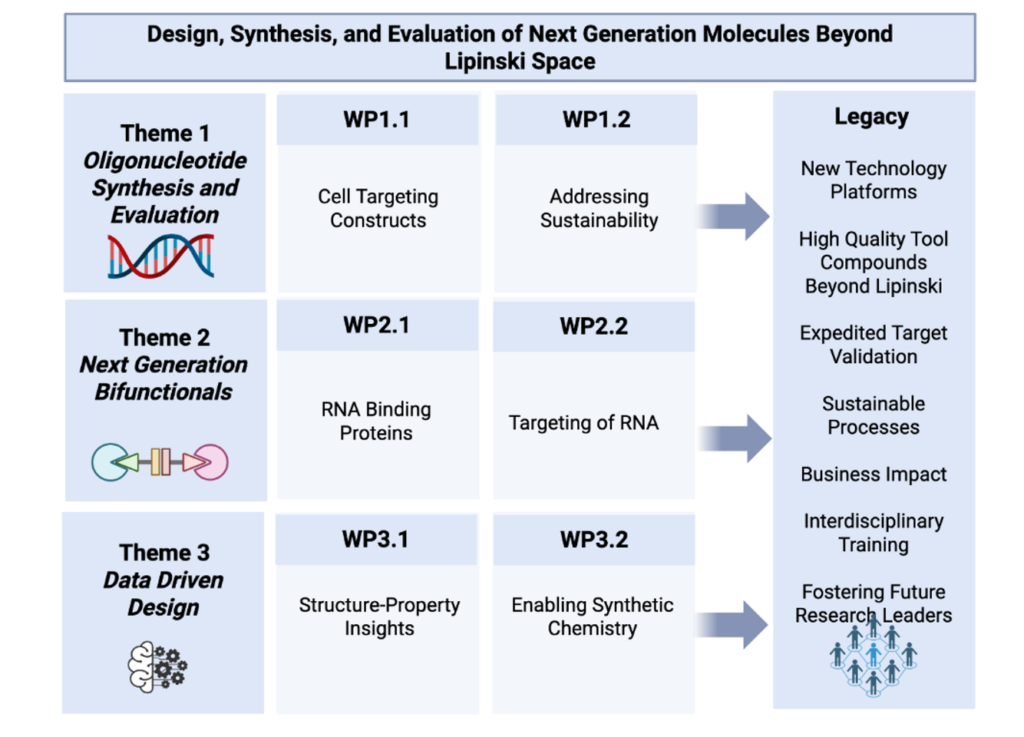
Aligned with the EPSRC Prosperity Outcomes of Health, Productivity Resilience, and Connectivity, the complementary expertise of the University of Strathclyde and GSK, the flexibility of the Prosperity Partnership model, and associated co-funding framework, allows for an ambitious research programme spanning three key Themes, and with the following objectives:
(i) Develop new approaches for the delivery of oligonucleotide (ON) therapeutics to a desired cellular address, including delivery of an integrated technology platform to optimise cellular delivery and evaluation of ON payloads;
(ii) Develop a high-throughput experimental platform for the synthesis and evaluation of heterobifunctional species capable of manipulating RNA-binding proteins and/or RNA in a cellular context;
(iii) Accelerate the design and synthesis of emerging modalities by leveraging advanced data and computational approaches; and
(iv) Generate demonstrable impact through translation of methods developed into the industrial partner and adoption by the wider scientific community.
The research Themes are driven by three key principles: data-driven decision making; understanding of structure, reactivity, and mechanism; and prediction of structure-property/structure activity relationships using AI/ML methods
Figure 1 illustrates the overarching vision of the Prosperity Partnership.